
2024
Qubera: An AI Research Tool for High-Stakes Financial Decisions
Financial analysts were losing hours every night reading documents that a well-designed AI could summarize in seconds. I designed the end-to-end product experience for Qubera — an AI-powered research tool built to cut through the noise and get analysts to the insight faster.
Role: Product Designer, Conversational Designer
Duration: 6 weeks
Scope: User research, information architecture, wireframing, prototyping, design system
Tools: Figma, FigJam, Jira

The Users
Junior to mid-senior financial analysts — the people who do the actual research behind investment decisions. They spend hours, sometimes entire nights, reading through 10-Ks, 10-Qs, and press releases. They're working under real pressure: a company releases earnings, the market moves, and an analyst has a narrow window to read, interpret, and make a call.
What surprised me during research: the bottleneck wasn't intelligence or expertise — it was time and access. Analysts knew what questions to ask. Getting to the answers was what was consuming them.
The Problem
Equity research is built on publicly available information — SEC filings, earnings reports, press releases. But accessing, parsing, and synthesizing that information manually takes 15+ hours per analyst per cycle. By the time an analyst has read everything they need, the window for timely decision-making has often already closed.
The goal: design an AI tool that cuts extraction time dramatically and gets analysts to the questions that actually require their judgment.
The Time Constraint
We were building fast. Financial institutions were already in conversation with the team — during one research interview, a director told us she was waiting for the product to launch because she wanted her analysts using it immediately. That kind of validation accelerated everything.
The design had to be production-ready quickly, which meant making deliberate decisions about what to include in the MVP and what to defer.
What I Designed
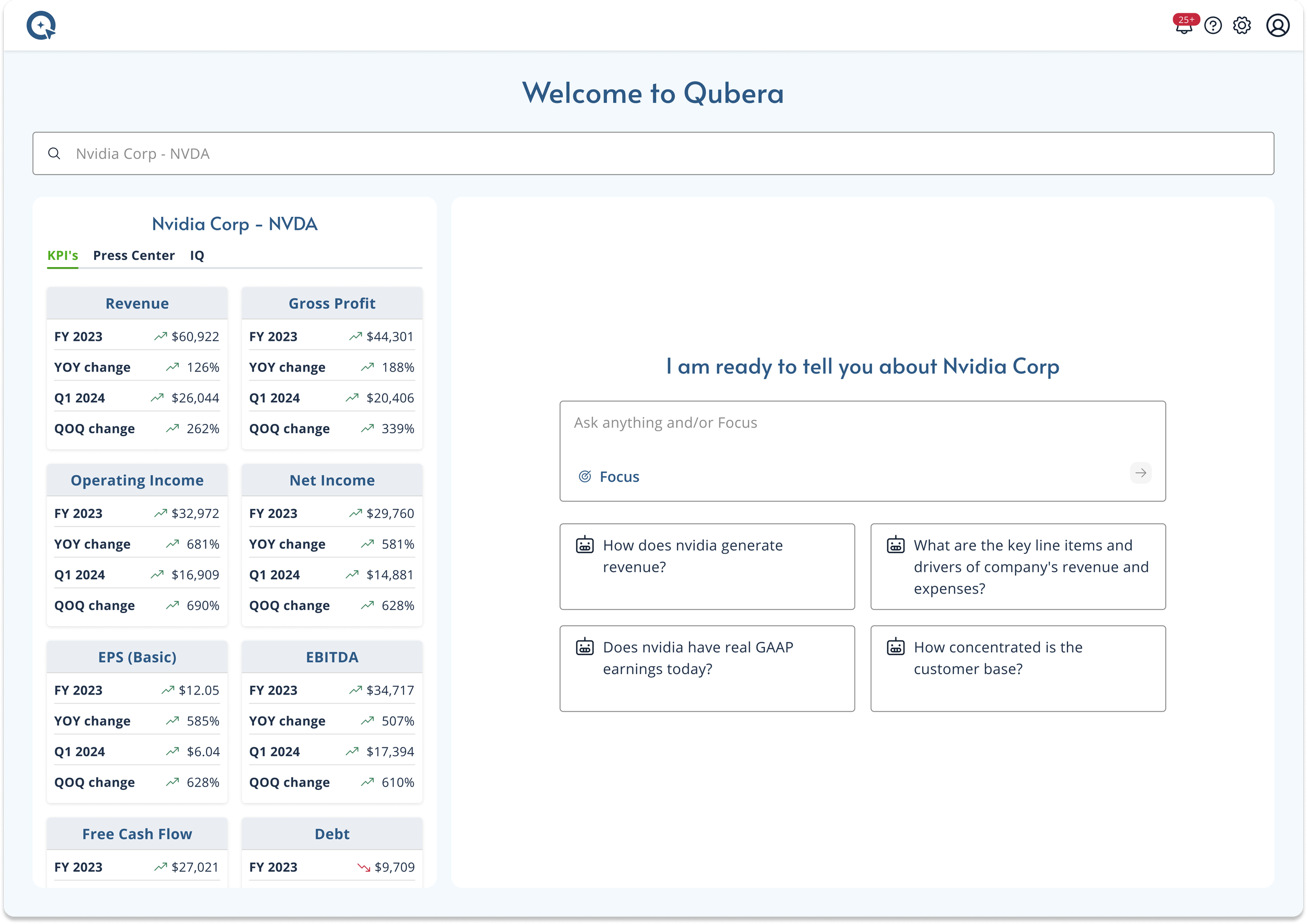
Default View — Key Financial Metrics
When an analyst selects a company, the most critical financial numbers are already there — revenue, gross profit, net income, EPS, EBITDA, free cash flow, debt — automatically parsed from 10-Ks and 10-Qs. No manual extraction. No hunting through filings.
This single feature reduced data extraction time by 85%.
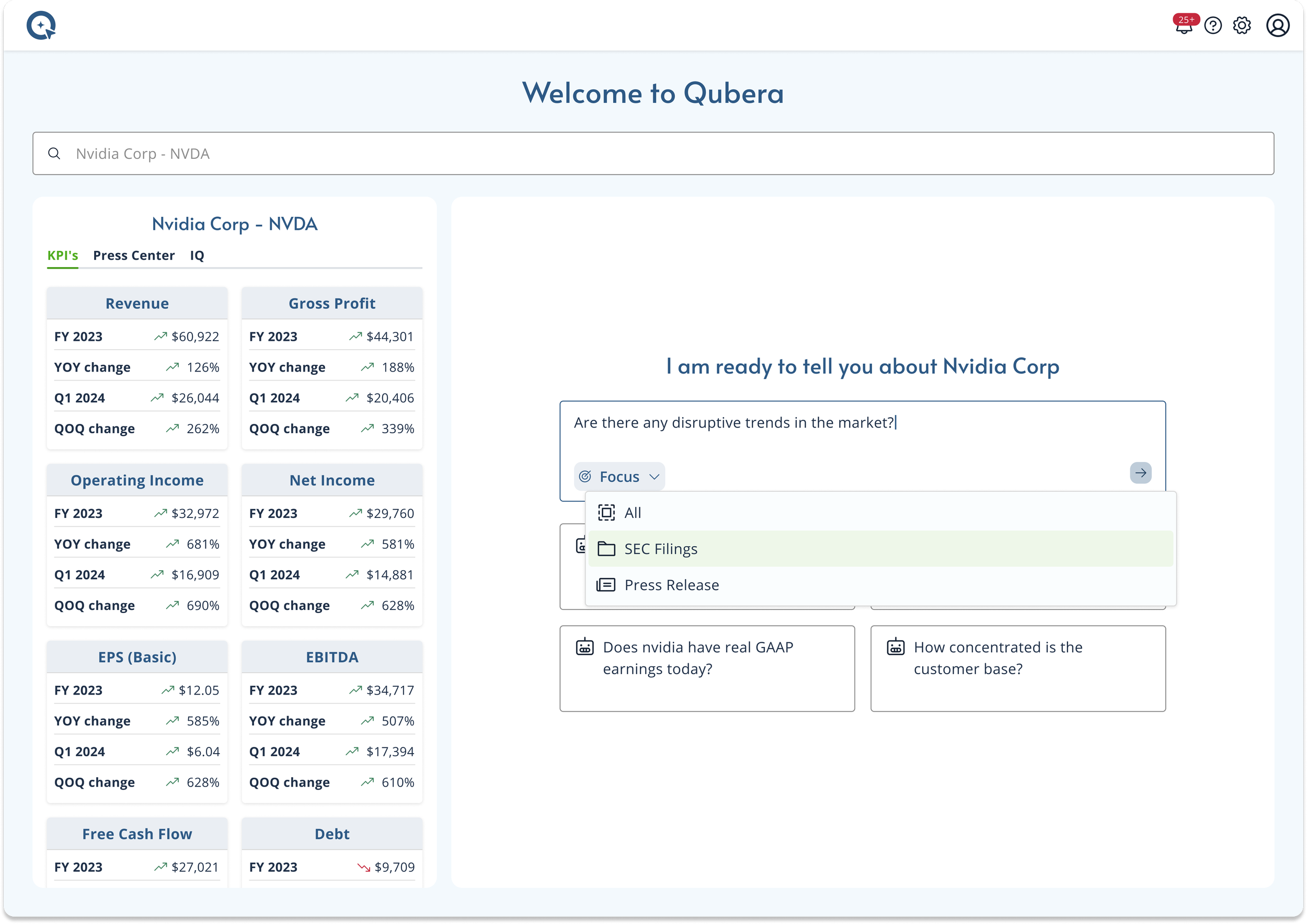
Focused Chat
Analysts can query the AI directly, focused on specific documents — SEC filings, press releases, earnings calls. They can type a question or select from pre-generated prompts. The AI responds with sourced, specific answers.
This boosted decision-making speed by 30% — analysts could ask targeted questions and get targeted answers instead of reading entire documents to find one data point.
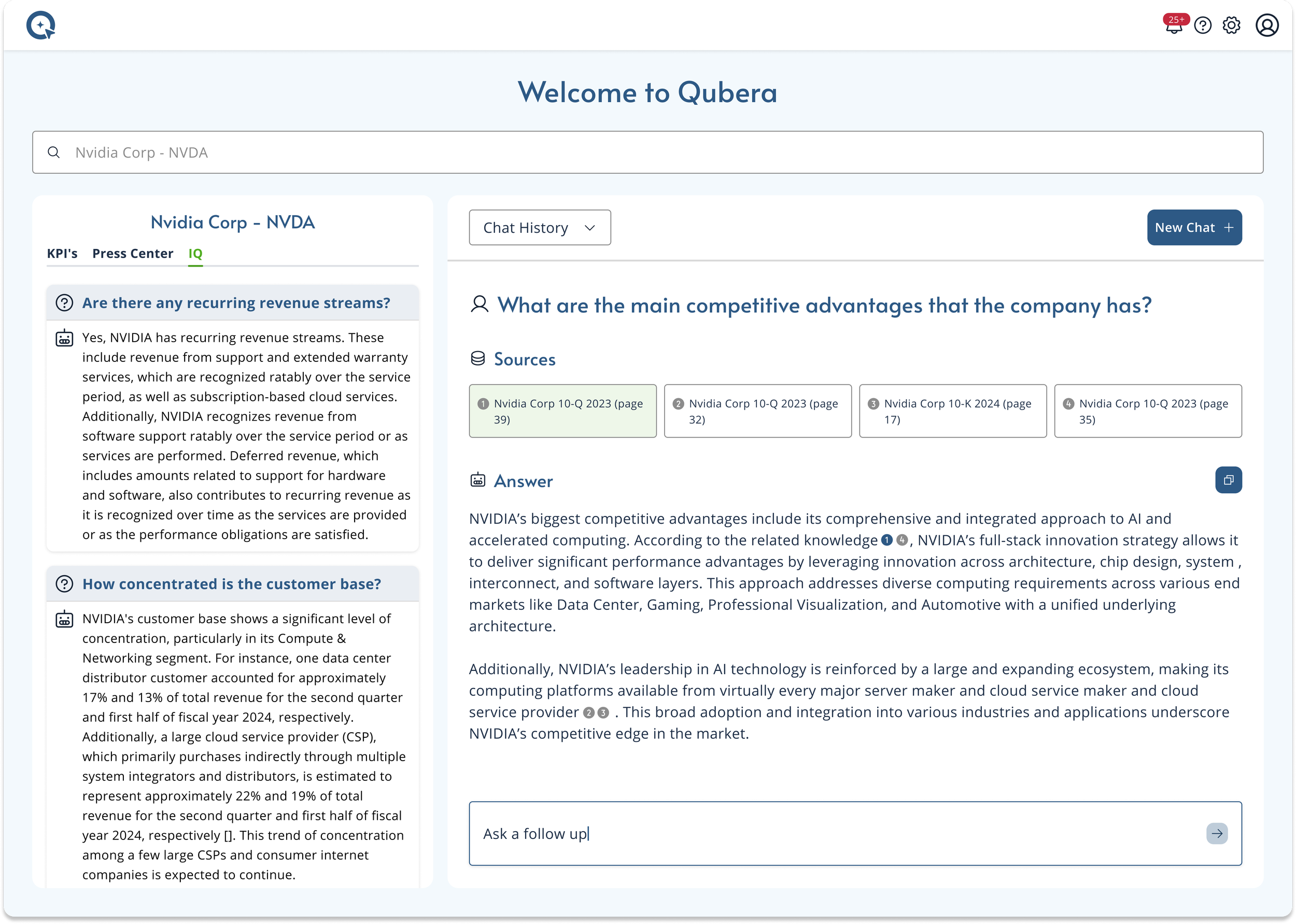
Intelligent Questions — My Proposal
During research interviews, a pattern emerged: analysts ask largely the same set of questions about every company they cover. Revenue growth, competitive positioning, key risks, guidance. The questions were consistent — only the answers changed.
I proposed the Intelligent Questions feature: when an analyst selects a company, a curated set of pre-answered questions is already waiting for them. No typing, no repetition, no cognitive overhead of deciding what to ask first. More importantly, it shifts where analysts spend their mental energy — routine questions are handled, so they can focus on the complex, high-judgment questions that actually require their expertise.
The MVP delivered a standard set of IQ questions for every company. The roadmap included a future version where analysts could build and save their own personalized question sets — we designed for that extensibility even though we didn't ship it in V1.
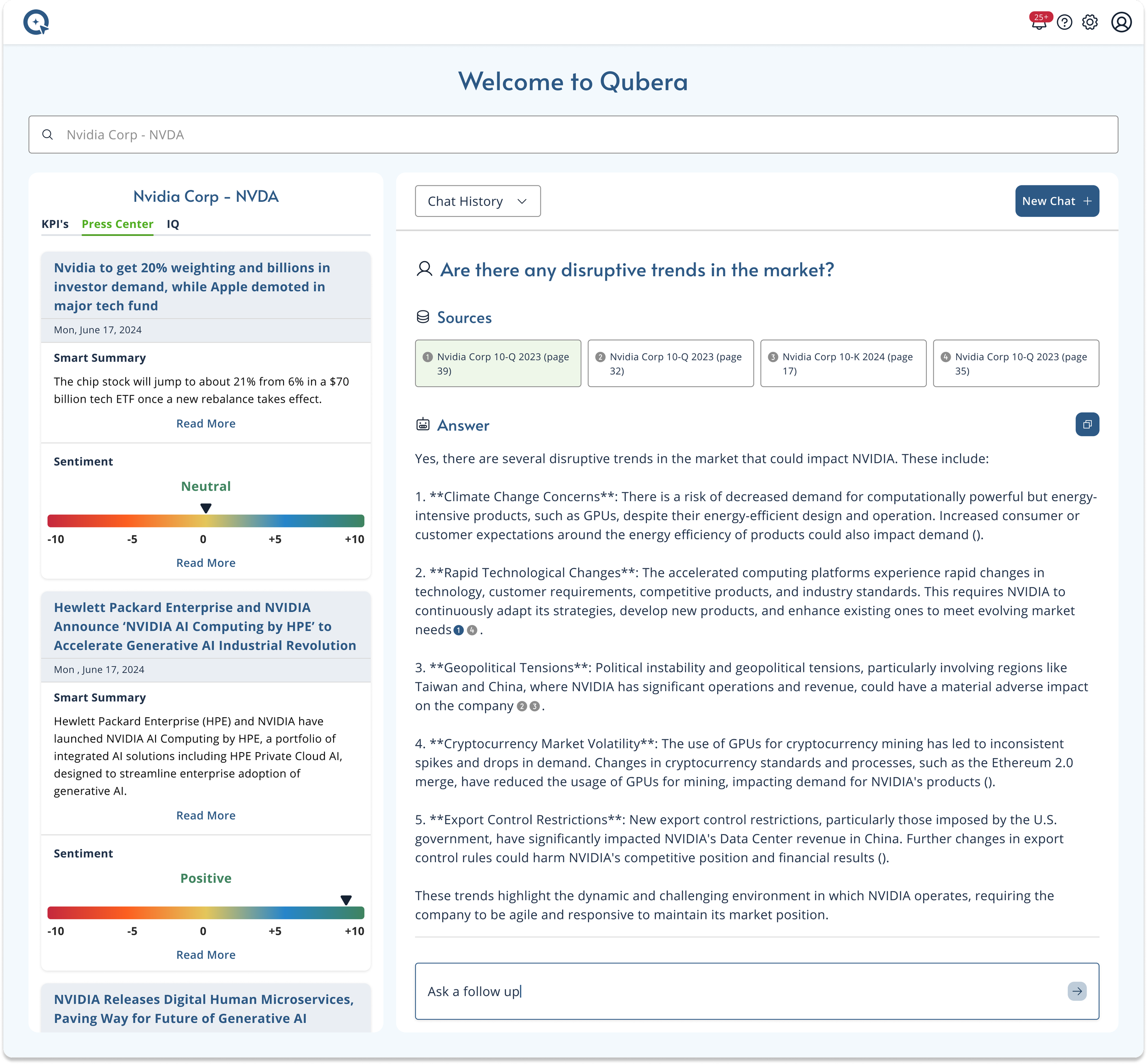
Press Release Summaries and Sentiment Analysis
New press releases are summarized automatically. Analysts see a sentiment score on a color-coded scale — positive, neutral, negative — without having to read the full release first. If something warrants deeper attention, it's one click away.
Validation
Testing was done with actual clients — financial analysts and institutional users who were evaluating the product for adoption.
Formal documented feedback wasn't captured before the project concluded, but the real-world signal was clear: a director at a financial institution was actively waiting for launch to put her team on it.
Impact
85% reduction in data extraction time
30% faster decision-making for analysts using focused chat
Designed and shipped MVP in 6 weeks
Product positioned for launch with active institutional interest
Reflections
This project taught me how much context matters when designing for expert users. Financial analysts aren't confused about their work — they're constrained by the tools available to them. The design challenge wasn't simplification. It was elimination — removing every step between an analyst and the insight they were already capable of drawing.
The IQ feature is the decision I'm most proud of. It came directly from listening carefully during research, noticing a behavioural pattern, and proposing a solution that addressed it systematically rather than feature by feature.
What I'd do differently: structure client testing more formally from the start. We had real users evaluating the product but no structured feedback capture. That data would have been valuable both for iteration and for telling the story of this project.
The best AI tools don't replace expert judgment — they clear the path to it.